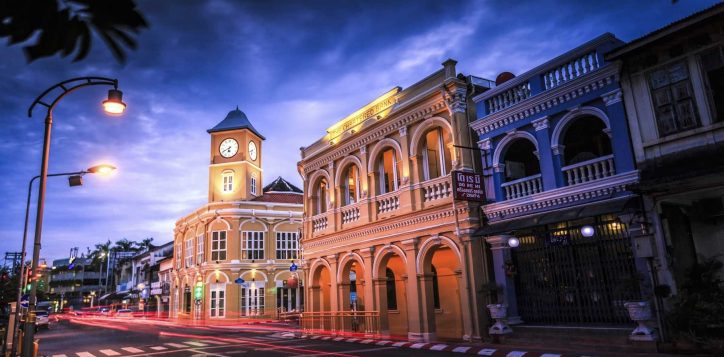
Old Town Phuket



The Rich History of Phuket Old Town
Old Town Phuket is the historic heart of the island, a grid of narrow streets lined with Sino-Portuguese shophouses in faded pastel colours. It sits inland from the beaches, and it is where Phuket’s trading past is still visible in the buildings, the food and the markets. Most visitors come for an afternoon and stay into the evening.
The markets in Old Town Phuket
The markets are the main reason to time a visit carefully. The Sunday Walking Street, known locally as Lard Yai, closes Thalang Road to traffic and fills it with food stalls, craft sellers and street performers along the oldest stretch of shophouses in the town. It is the busiest and most atmospheric the Old Town gets.
Beyond the walking street there are night markets in and around the Old Town trading in street food, clothing and household goods, with a more local and less tourist-oriented feel. Market days and trading hours do change, so it is worth checking the current schedule before setting out rather than relying on an old listing.
The colourful streets and shophouse architecture
The painted shophouses are what most people photograph. Thalang Road is the main spine and the most photographed stretch, with two-storey facades in pink, yellow, blue and green, arched colonnades shading the pavement, and shuttered windows above.
Soi Romanee, a short lane running off Thalang Road, is the most concentrated of them. Once the town’s red-light street, it is now a quiet row of restored houses, guesthouses and small cafes, and it is the best place to see the architecture at close range. Dibuk Road, Krabi Road and Phang Nga Road carry more of the same, with fewer people on them.
The style is Sino-Portuguese: Chinese building traditions brought by Hokkien migrants, combined with European colonial detailing picked up through the regional trading ports. It is the same architecture found in Penang and Malacca, and in Phuket it survives in an unusually complete stretch.
Things to do in Old Town Phuket
Beyond walking the streets and eating, the Old Town rewards a slow afternoon. Small museums explain the tin-mining years that built the town. Chinese shrines sit among the shophouses and remain in daily use. Independent galleries, coffee roasters and design shops have taken over many of the restored buildings, and street art has appeared across side walls and shutters.
It pairs naturally with other inland stops, including Big Buddha Phuket which sits on the hills between the Old Town and the west coast beaches. More options are on the things to do in Phuket guide.
Where to eat in Old Town Phuket
The food is a genuine reason to come. Phuket’s cooking draws on Hokkien Chinese and southern Thai traditions, and the Old Town is where that shows most clearly. Hokkien noodles, dim sum eaten at breakfast, local curries and shaved-ice desserts all have long-established places here, many of them family-run across several generations and occupying the same shophouse for decades.
The history behind the architecture
Phuket grew wealthy on tin. Through the nineteenth century the mines drew large numbers of Hokkien Chinese migrants, and the merchants who prospered built the shophouses and mansions that still define the Old Town. Their wealth paid for the European detailing, while the layout and interior arrangement stayed Chinese. When tin declined the town was left largely intact, which is why so much of it survives today rather than having been redeveloped.
Getting to Old Town Phuket from Cape Panwa
From Cape Panwa the drive runs north around the bay into Phuket Town, and the Old Town sits at its centre. Parking is limited on the historic streets and closed off entirely during the walking street, so most visitors park on the edge and walk in. Allow time to get back out again on market evenings, when the surrounding roads are busy.
FAQs about Old Town Phuket
Q: Where is Old Town Phuket?
A: In the centre of Phuket Town, inland from the beaches on the eastern side of the island.
Q: What is Old Town Phuket known for?
A: Sino-Portuguese shophouses in pastel colours, the Sunday Walking Street market on Thalang Road, and Hokkien-influenced southern Thai food.
Q: What is the Sunday Walking Street?
A: Known locally as Lard Yai, it closes Thalang Road to traffic and fills it with food, craft and performance stalls. Check current timings before travelling.
Q: Which street is the most photogenic?
A: Soi Romanee, a short lane off Thalang Road, has the most concentrated run of restored colourful shophouses.
Q: How long should I spend in Old Town Phuket?
A: An afternoon into the evening suits most visitors, long enough to walk the streets, eat and see a market if the timing works.
Access
Pullman Phuket Panwa Beach Resort ☆☆☆☆☆
44/5 Moo 8 Sakdidesh Road, Vichit, Muang , 83000 Phuket
Thailand
Tel: +66 76 602 500
Fax: +66 76 602 555
Email:
info@pullmanphuketpanwa.com